 An official U.S. government website


Media Release
- By Stephen Staudigl
- March 08, 2019
NCPC Approves Revised National Zoo Perimeter Fence Plans
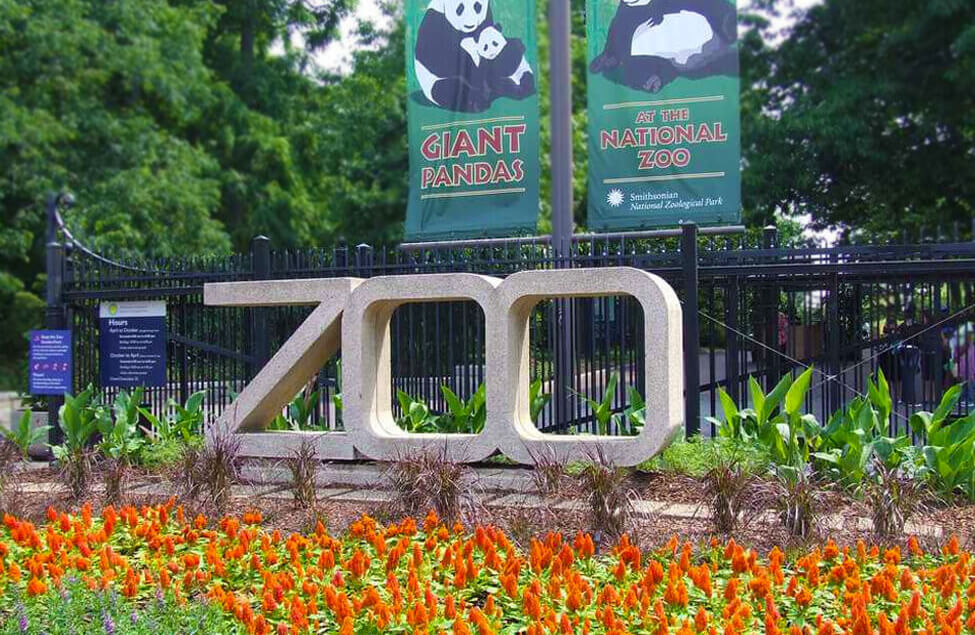
Washington, DC—At its March 7 meeting the National Capital Planning Commission (NCPC) approved preliminary and final site development plans submitted by the Smithsonian Institution for supplemental perimeter fencing at the National Zoo , located in Northwest Washington, DC. The project was originally submitted in July 2018, but NCPC postponed action due to outstanding questions from the public and Commission regarding the need for the enhanced security measures.
The submission had two components. The first is the consolidation of visitor entry points to enhance safety and security, improve visitor wayfinding, and better protect the animals. The second component will close gaps in the existing perimeter fencing to better contain the zoo’s animals in the event of an escape and to protect them from surrounding wildlife.
The zoo currently has three vehicular entrances and 13 pedestrian entrances (three primary and 10 secondary). The revised plan will maintain the vehicular and three primary pedestrian entry points (Connecticut Avenue, bus lot drop off, and lower zoo) while decreasing the informal entry points to three while still providing direct access to/from Parking Lots A, B, and C. In addition, 4,205 feet of new fencing will fill in current gaps. All the fencing added will be similar in type to fencing already at the zoo.
The Smithsonian indicated that this revised submission responds to feedback received from local leaders, civic groups, and the public, and includes major changes such as eliminating permanent security screening pavilions from further consideration. Commissioners appreciated the National Zoo’s outreach to the public and it’s response to the concerns of the public and NCPC in the revised submission.
“This project it is greatly improved since the last time NCPC saw it,” said Commissioner Beth White.
NCPC then provided comments on a concept design submitted by the Washington Metropolitan Area Transit Authority to add canopies at five Metrorail stations located on National Park Service land. The Commission previously approved the project’s first three phases for canopies at 39 sites (29 are installed, 10 are in progress of installation). The Commission noted their support for the project which improves escalator reliability, protects passengers from the elements, and provides a dignified and elegant entrance to Metrorail stations.
The original canopy prototype, a glass and metal structure, references the vaulted ceiling in the Metro stations, and is widely recognized by the public, providing wayfinding to Metro entrances. The current submission is for canopies at station entrance sites located in historic settings and/or important viewsheds. WMATA developed two variations to the original canopy prototype that vary in height and flatness. The Commission noted that the third option was inappropriate for any of the five sites because its flattened appearance is too different from the canopy prototype.
The Commission provided feedback on each of the five locations.
1. Archives-Navy Memorial-Penn Quarter station: The original prototype was an appropriate design option because it would not have any negative impacts on historic buildings or important views.
2. Arlington Cemetery station (both the north and south entrance locations): The second option is appropriate because its lower height would decrease the visual impacts on important views along Memorial Avenue.
3. Judiciary Square North: The second option is appropriate because it would minimize impacts on views towards the National Building Museum and through the National Law Enforcement Officers Memorial.
4. Smithsonian station: Option two is also appropriate here to minimize impacts on important views on the National Mall.
5. U Street/African-American Civil War Memorial Station: The original prototype is the appropriate design option because it would not have any negative impacts on historic buildings or important views.
The Commission then approved preliminary and final site and building plans submitted by the DC Office of the Deputy Mayor for Planning and Economic Development to transform downtown’s Franklin School into Planet Word. Planet Word will be a museum focusing on language, and NCPC said that the transformation will provide much needed improvements to the building that is a National Historic Landmark.
NCPC noted that a Memorandum of Action, prepared and executed in response to the unauthorized removal of historic fabric and other components of the building’s interior, would allow for the replication of many of the character-defining features removed, and laid out the review and consultation process for the rest of the project. The Commission found the museum’s proposed new entrance plaza off K Street appropriate with its metal entry gate, paving materials, and Speaking Willow plaza sculpture. NCPC also found that the proposed museum’s signage will provide needed identification and won’t have any negative impacts on the historic building.
The Commission then provided comments to the District Department of Transportation (DDOT) on the final draft Small Cell Infrastructure Guidelines. DDOT is the lead agency and liaison with the cellular providers who want to install small cell infrastructure, a new lower-powered antenna technology, along public right of ways and other areas throughout Washington. DDOT developed small cell guidelines to inform the placement of these small cell facilities through specific criteria related to context, location, and aesthetics.
“We appreciate that the District Department of Transportation incorporated the Commission’s prior comments and recommendations into the final draft guidelines and worked closely with our staff on this complex and important effort,” said NCPC Vice Chairman Thomas Gallas. “The Commission looks forward to continue working with them, other agencies, and cellular carriers, over the next several months to develop a design standard for standalone poles that befits our nation’s capital.”
In its comments NCPC noted that the Federal Interest Area map adopted by the Commission is included in the final guidelines. The map identifies permissible locations for small cell facilities in areas around the National Mall. No small cell infrastructure will be allowed in areas adjacent to federal reservations outside this area. The Commission also expressed its preference for hoteling small cell infrastructure wherever possible.
Before adjourning NCPC heard an information presentation by representatives from the General Services Administration and their consultant team on updates to the master plan that will transform the 186-acre St. Elizabeths West Campus into the consolidated headquarters for the Department of Homeland Security. They noted that the original plans to renovate many of the existing historic buildings has changed due to budget constraints and new program requirements. Plans now call for the addition of new construction on the campus at the expense of some of the historic buildings. GSA plans to submit a revised master plan for NCPC review later in 2019. No action is taken on information presentations.
This month’s agenda included 10 consent calendar items (no presentation given):
1. Sprint telecommunications facility upgrades at the Export-Import Bank, Lafayette Federal Building, 811 Vermont Avenue, NW. (8050)
2. Preservation of Meridian Hill Park-Phase V and VI, Northwest Washington, DC. (7642)
3. Removal of a portion of 39th Street, NW, from the Permanent System of Highways, Lot 801, Square 1823, between Upton and Rodman Streets, NW, west of Wisconsin Avenue, NW. (8036)
4. Renovations and an addition to the Washington DC VA Medical Center Oncology and Cancer Center, 50 Irving Street, NW. (8038)
5. Sprint telecommunications facility upgrades at the U.S. Office of Personnel Management, Theodore Roosevelt Federal Building, 1900 E Street, NW. (8041)
6. Sprint telecommunications facility upgrades at the U.S. Department of Housing and Urban Development, Robert C. Weaver Federal Building, 451 7th Street, SW. (8046).
7. Sprint telecommunications facility upgrades at the U.S. Department of Energy, James V. Forrestal Building, 1000 Independence Avenue, SW. (8047)
8. Sprint telecommunications facility upgrades at the U.S. Department of Labor, Frances E. Perkins Federal Building, 200 Constitution Avenue, NW. (8048)
9. Sprint telecommunications facility upgrades at the U.S. Department of Health and Human Services, Hubert H. Humphry Building, 200 Independence Avenue, SE. (8049)
10. Sprint telecommunications facility upgrades at the U.S. Department of Commerce, Herbert C. Hoover Federal Building, 1401 Constitution Avenue, NW. (8051)
The Executive Director approved six items under authority delegated by the Commission.
1. Preliminary and final site development plans for the installation of an interim fence around the Hollies and Creamery at St. Elizabeths West Campus, 2700 Martin Luther King, Jr. Avenue, SE. (8045)
2. Preliminary and final site and building plans for an addition at the Building 51 Fire House, National Institutes of Health, Center Drive, Bethesda, MD. (8054)
3. Final site and building plans for rehabilitation of the Netherlands Carillon, Arlington Ridge Park, Arlington, VA. (7969)
4. Preliminary site and building plans for a Backwash Equalization Pumping Station at the McMillan Reservoir, 2500 1st Street, NW. (8042)
5. Approval of a report to the Zoning Commission of the District of Columbia regarding a Map Amendment from PDR-1 to MU-4 and MU-5A, Ward 6, bounded by K, 2nd, I, and 3rd Streets, NE Square 750, Lots 128, 156-158. (ZC 18-07)
6. Approval of a report to the Zoning Commission of the District of Columbia for a Text Amendment regarding community renewable energy facility definition and permitted use location. (ZC 19-04)

