 An official U.S. government website



- By Julia Koster
- September 03, 2019
The REACH Grand Opening
As the Kennedy Center prepares to celebrate the grand opening of the REACH on September 7, NCPC extends its congratulations to Executive Director Deborah Rutter and the amazing team whose vision, creativity, and hard work produced this exciting new space for Washington, DC and the nation.
I’m ready to attend the festivities, but until they start, this is a chance to reflect on how this project addresses some of NCPC’s long-standing planning interests and how the Commission’s review shaped the outcome we see today. Some things to think about include: How can memorials engage new audiences over time? How do we adapt 20th century buildings and landscapes? How can we better connect our capital city destinations, and make them more accessible to more people?
NCPC has over the years, discussed with Kennedy Center representatives issues including space constraints and the center’s lack of connections, with a focus on the need to improve access, parking, and rehearsal spaces. Ideas ranged from Rafael Vinoly’s dramatic decking idea to a more modest, recent proposal to build steps from the terrace to the riverfront.
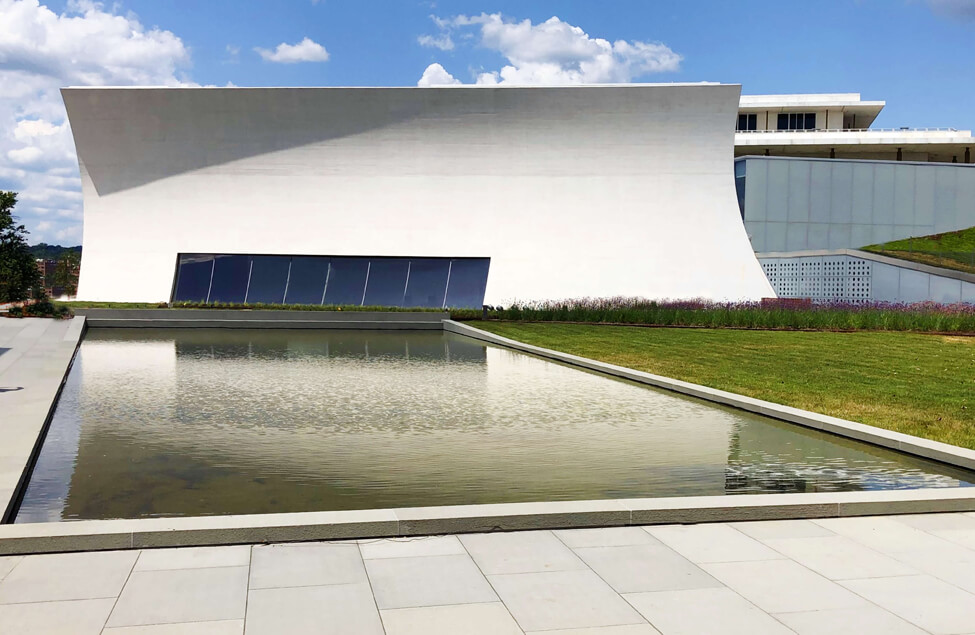
Stephen Holl’s design to rethink the southern half of the site with below-grade rehearsal spaces and parking, while creating new outdoor public spaces and performance venues marked by striking white buildings, was approved by the Commission on July 9, 2015, with approval of the related pedestrian ramp and bridge over Rock Creek Parkway on July 7, 2016. One initial idea, to have a floating performance venue in the Potomac River, ran into controversy as various boating groups raised concerns about navigation.
While the floating pavilion concept didn’t advance, it remained critically important to connect the Kennedy Center to the Potomac River. Revised proposals called for a bike and pedestrian bridge over Rock Creek parkway to connect the REACH to the existing waterfront trail. As part of its review, the Commission considered the choice between a traditional design reflecting the many historic bridges crossing the parkway, or a minimal modern design nodding to the aesthetic of the REACH, ultimately selecting the latter. NCPC’s 1997 Legacy Plan sought to connect the Kennedy Center to the Potomac Waterfront, and this new bridge fulfills that goal.
The road spaghetti surrounding the Kennedy Center separates it, both physically and perceptually, from nearby uses. We forget that that the Kennedy Center is only a 1/2 mile from the Lincoln Memorial. The outdoor activity at the REACH, and the new pedestrian bridge, will help build important connections to the National Mall and the Potomac River.
Connections are created in other contexts. The Kennedy Center is a living memorial to a president and to a moment when our country struggled with great challenges, but was inspired by bold ideas. As the generation of people that lived through the Kennedy Administration grows older, how is President Kennedy’s legacy brought to life for future generations? The REACH helps connect new audiences through new visual references, from quotations to the names of new rooms, and we look forward to future ways, whether digitally or through performance, that can bring additional layers of meaning.
Similarly, the REACH also reflects Washington’s ongoing dialog as a city that respects its historic design legacy, while embracing new approaches. Across the city and region, many 20th century buildings and landscapes are under consideration for adaptations to respond to changing needs, technologies, and preferences. The REACH represents a thoughtful, bold, and modern intervention that updates the identity of the Kennedy Center while maintaining the power of the Edward Durell Stone's 1960's design.
The REACH is an example of how Washington’s many destinations are rethinking the visitor experience. Whether sitting on the lawn to enjoy a telecast of the National Symphony, or delighting in the opportunity to see rehearsals, the REACH unwraps the creative process and democratizes access to the performing arts in exciting ways. NCPC has recently seen a number of proposals from cultural institutions to reshape their physical space in support of improved visitor experiences. The District of Columbia's new Cultural Plan, as well as NCPC’s initiative for Pennsylvania Avenue, are examples of plans exploring how our public spaces act as stages for large and small events and celebrations.
Grand Opening Info

