 An official U.S. government website



- By Dana Marks*
- August 17, 2018
Washington’s Streetlights: Illuminating the Capital City One Road at a Time
While their primary objective is to provide light to pedestrians and motorists at night, streetlights are also an important element of the urban fabric and often contribute to the historical significance of specific neighborhoods.1 Today, there are more than 70,000 streetlights in a variety of styles and dimensions throughout Washington, DC. What style to use on each street is often determined by the street’s classification and historic district designation. Here we will explore the design of some of Washington’s iconic streetlight fixtures, and where to find them in the city.
But first, who is responsible for street lighting in the city? A number of agencies have influenced the design of streetlights over the last 100+ years, starting with the U.S. Commission of Fine Arts (CFA), which had review authority on the design and aesthetics of streetlights from its inception in 1910 until the District of Columbia established Home Rule in 1973. At that time, the design and implementation of streetlights became the purview of the District of Columbia Department of Public Works until 2002, when the District of Columbia Department of Transportation took over responsibility for street lighting in the city, and maintains that role today. There are parts of the city, however, like the National Mall and Capitol Grounds, where the streetlights are the responsibility of federal agencies – in this case the National Park Service and Architect of the Capitol, respectively. Many of the fixture styles identified below can be found on both federal and district property.

Washington Globe
The Washington Globe is the city’s most iconic streetlight fixture. The original globes were designed in 1910 by Francis D. Millet, CFA Vice Chairman (1910-1912), and were incorporated into the 1923 Lighting Plan by the Committee on Lighting Needs of the District of Columbia. They can be found on many of Washington’s downtown streets and bridges. Washington Globes can have various pole heights, but all have the same Millet design aesthetic.
Twin-20
Complementing the Washington Globe, Lincoln Memorial architect and CFA Commissioner (1921-1924) Henry Bacon designed the Twin-20 street light fixture in the 1920s to express the federal city’s dignity. These streetlights incorporate two lamps, intended to be oriented parallel to the street to reinforce a linear direction, on a single upright pole very similar to the Millet design. Fixture ornamentation can vary depending on location and model. For example, the Twin-20s adjacent to the U.S. Department of State have distinctive ornamentation compared to those surrounding the National Mall on Constitution and Independence Avenues. After its initial development, Bacon’s Twin-20 street light was incorporated in the District’s 1923 Lighting Plan. Twin-20s can be found on major avenues and streets within Washington’s monumental core, Dupont Circle, Washington Circle, and at several entry points into the city.
Cobra
Not to be confused with venomous snakes, cobra head light fixtures are common along freeways and highways, and provide lots of downward facing light to comply with traffic safety standards. These simply designed streetlights first came into use during the 1950s for the purposes of illuminating streets and sidewalks from a lamp attached to a standalone or utility pole by a protruding arm. They can be found throughout the city, including on Theodore Roosevelt Bridge, the 14th Street Bridge Complex, and in the Capitol Hill neighborhood. Variations of cobra heads can have one or two arms.
Teardrop
Adopted throughout Washington, teardrops are a decorative alternative to cobra heads that fulfill similar lighting requirements at intersection corners and in historic districts. Additionally, teardrops provide “more pleasing aesthetic and architectural qualities for outdoor lighting.”2 These streetlights have a downward facing pendant light hung from an ornamental arm extending from the pole. They come in a variety of styles throughout the city in addition to intersection corners downtown. H Street, NE has its own distinct teardrops that are unique to the corridor. Residential areas in Northwest, including the U.S. Naval Observatory,3 Kalorama, and Mount Pleasant, have much older teardrops that are rare and are often found on wood utility poles.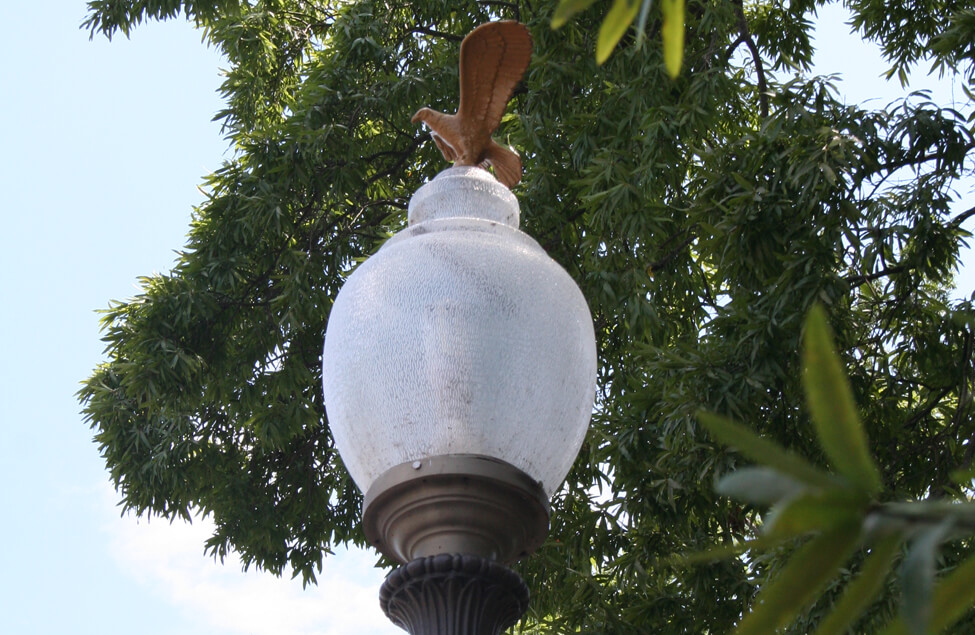
Pennsylvania Avenue Streetlights
Pennsylvania Avenue between the U.S. Capitol and the White House has three unique light fixtures as a result of the Pennsylvania Avenue Development Corporation’s (PADC) work in the 1970s. To accommodate for transportation along the roadway, the PADC designed cutoff luminaries mounted on poles set back from the curb and centered on the tree line. Tree uplights mounted on poles adjacent to the trees provide lighting for sidewalks and pedestrian areas.4 The third and most decorative type of street light is a special iteration of the Washington Globe with an eagle finial on top of the luminary globe. It emphasizes the prominence and importance of Pennsylvania Avenue as a symbolic and material connection between the White House and the Capitol.
10th Street Mall (L’Enfant Special)
These light fixtures are only located along 10th Street, SW by L’Enfant Plaza. Two metal poles connected by a small black panel hold five luminary orbs. Four of the orbs sit on the same plane while the fifth rises above to be the highest point of the entire fixture. These streetlights run from the U.S. Department of Energy’s James V. Forrestal Building to Benjamin Banneker Park at the terminus of 10th Street, SW. Built in the 1960s, these lights contribute to the unique character of the 10th Street Mall, also known as the L’Enfant Promenade.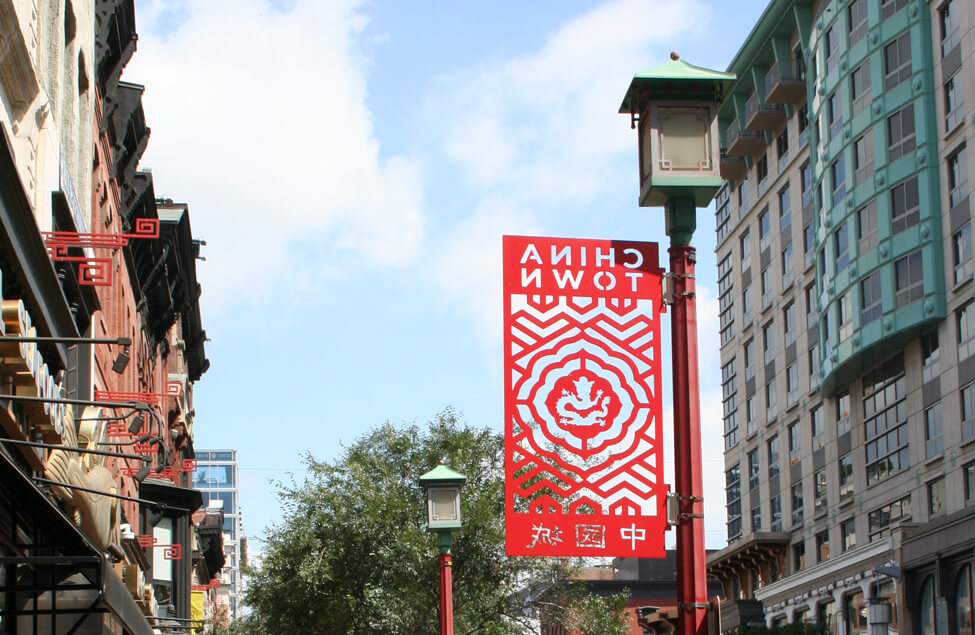
Chinatown Luminaire
Resembling a traditional lantern, each of the four sides of a Chinatown Luminaire are rectangular and have a decorative border around the light-emitting pane. These colorful red and green painted streetlights indicate the general boundaries of Washington’s Chinatown district, lining 6th, 7th, H, and Eye Streets, NW, bounded by 5th, 9th, and G Streets, NW and Massachusetts Avenue, NW. In addition to Chinatown’s signs, banners, and building ornamentations, these streetlights reflect the neighborhood’s Chinese heritage.52. 2013 DDOT Streetlight and Policy Standards, p. ES-1. ↩
3. Amy Worden, “Kalorama Cries Foul over Loss of Teardrop Street Lights” in The Washington Post, August 20, 1992.↩
4. 1977 Pennsylvania Avenue Development Corporation Lighting Plan.↩
5. National Park Service, "Downtown Historic District."↩

