 An official U.S. government website


Media Release
- By Stephen Staudigl
- September 06, 2022
NCPC Approves Preliminary Peace Corps Commemorative Park Plans
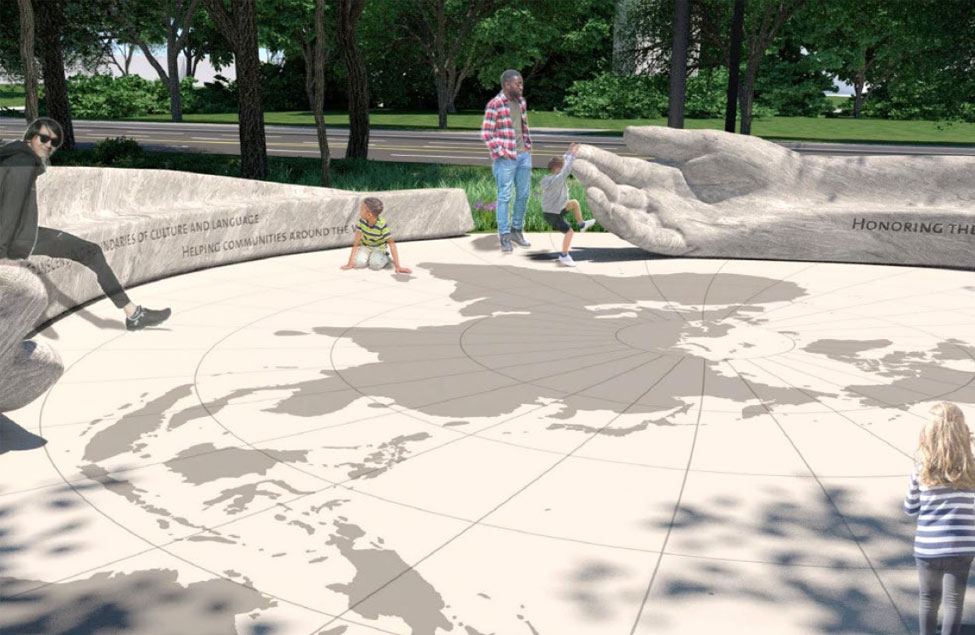
At its Thursday, September 1 Commission meeting, the National Capital Planning Commission (NCPC) approved preliminary site development plans for the Peace Corps Commemorative Park submitted by the National Park Service, in collaboration with the Peace Corps Commemoration Foundation. The park would honor the founding of the Peace Corps in 1961, the organization’s ideals, and its thousands of volunteers. It would be located on an approximately 7,200 square foot triangular park bounded by Louisiana Avenue and 1st and C Streets, NW. The project will come back to the Commission for final approval at a date to be determined.
The park’s design would symbolically interpret the Peace Corps’ mission and include an elliptical world map plaza, three granite benches with sculptural carved hands and inscriptions, trees, and shrubbery. Since the concept review the applicant, per the Commission’s previous comments, eliminated a proposed glass and metal pergola on two sides of the park and addressed issues related to tree retention and replacement. While Commissioners supported the updated plaza design and landscape approach, they recommended that the design of the sculptural benches be further developed and that the applicant consider a non-literal, more abstract design of the hand elements.
“Overall, I am supportive of the changes that have been made. The revised design is a big improvement and is much simpler. I like the landscape improvements and appreciate the applicant’s willingness to look at responding to the public testimony regarding expanding the landscape components,” said NCPC Chair Beth White. “However, I am still struggling with the depiction of the hands and the somewhat life-less color and appearance of the attached benches. From a planning perspective I have to take into consideration how people experience a place. The design is incredible and well sculpted but think that the applicant should consider something more abstract and the possibility of having two hands instead of three.”
The Commission then provided feedback on concept plans for temporary security measures at the National Archives Building. The temporary measures would be added on parts of 9th and 7th Streets, NW and Constitution Avenue to protect pedestrians at the Archives’ two Constitution Avenue entrances. The temporary measures would be in place while the National Archives develops permanent perimeter security and other visitor improvements that they seek to have installed by 2026. NCPC will review this permanent security strategy at a later date.
The Commission noted that the National Archives Building’s setting and prominence requires a restrained, context sensitive approach to any permanent perimeter security elements and advised the Archives that the temporary security measures’ location, even though they are on National Archives property, may not be appropriate for permanent security elements. For the next review stage, Commissioners requested more information about security needs and an update on the permanent perimeter security design approach. They also encouraged the Archives to work with other federal and local review agencies regarding the permanent design approach, which should include options and analysis of perimeter security placed within the building yard.
Next, NCPC approved preliminary and final site and building plans submitted by the Army for an approximately 525,000 square foot distribution center on Fort Belvoir’s North Area in Springfield, Virginia. The North Area is a non-contiguous portion of Fort Belvoir located northwest of the main base. The center would process and distribute supplies worldwide in support of the intelligence agency. It would include a one-story 295,000 square foot storage and operations building and an attached 92,000 square foot two-story administration building. Other components include a vehicle maintenance facility; entry control facility, perimeter security fence; solar array system on building rooftops and surface parking; bioretention, meadow plantings; and tree preservation areas.
In its approval Commissioners noted that the Army reduced the center’s development footprint as much as possible while meeting mission and programmatic needs. They commended the Army for incorporating a robust sustainability program and said that future projects’ proposed parking may need to be reduced in order to meet the long-term parking ratio of 1 (space):2 (employees) established in its’ area development plan. NCPC also noted that while the Army evaluated locating the perimeter security fence further away from the northern property line, security requirements and environmental constraints necessitate it at this location. As a result, the Army proposed several measures to limit lighting and maximize screening. Commissioners requested that the Army continue to work with the adjacent residential property owners to minimize these impacts.
The Commission then reviewed three district plans submitted by the Air Force for portions of Joint Base Anacostia-Bolling (JBAB). The installation is located in Southwest Washington, DC on the shores of the Anacostia River. JBAB’s Installation Development Plan divided the 966-acre base into four planning districts that will ultimately accommodate 27,000 employees. JBAB was formed in 2010 through the merger of the Naval Support Facility and the Anacostia and Bolling Air Force Base. The Air Force 11th Wing serves as the installation’s planning and general administrative group.
The Commission approved the final Sentinels of the Capital District Plan, which provides a detailed long-range guide for the development of the district as the installation’s secure, central tenant area and main workforce hub. It builds on the Installation Development Plan by providing more details regarding mission requirements, planning objectives, and command priority changes. In its approval, NCPC noted that the final plan includes information requested by the Commission regarding parking, future development sites, waterfront open space preservation, and the location of a future transit hub.
The Commission approved comments on the draft Housing and Community Support District Plan. The district, located on JBAB’s southernmost portion, is the base’s residential hub. It also includes a community support area (including a post exchange and commissary), recreational space, and open space. Commissioners supported the plan’s goals which include leveraging waterfront assets, providing development that supports military and community needs; and connecting and enhancing park-like corridors with trails, open space amenities, and increased tree canopy. Components include streetscape improvements, a new water taxi/fast ferry dock, waterfront enhancements, and new trees. Commissioners requested that the Air Force consult early with NCPC staff regarding the proposed reconstruction of the installation’s South Gate.
The Commission also approved comments on the draft Historic Anacostia District Plan. This district is on the installation’s northernmost portion and is its industrial hub, It includes administrative space and recreational/open space. Because most of it is located in 100-and 500-year floodplains, the Air Force plans to rehabilitee and upgrade the Anacostia River sea wall/levee. The district would house a Navy Ceremonial Guard campus quad and parade ground that would replace existing surface parking. In its comments, Commissioners requested that the Air Force consult early with NCPC staff on the proposed Firth-Sterling Gate reconfiguration and brief the Commission on efforts to implement renewable energy production. Recommendations include exploring the feasibility of connecting the levee path to South Capitol Street near the Frederick Douglass Memorial Bridge and to consult with NCPC and the DC State Historic Preservation Office regarding projects near the Naval Air Station Anacostia Historic District.
Smithsonian Institution representatives then provided a final update to the Commission on the Smithsonian’s site evaluation study for the National Museum of the American Latino and the American Women’s History Museum. Per the enabling legislation, the Smithsonian must determine sites for both museums by the end of 2022. NCPC has an advisory role in the site selection process but will have approval authority over site and building plans for both museums.
From an initial list of 27 potential sites, the Smithsonian developed 15 Tier I sites, and then identified four focus sites: the Arts and Industries Building, the South Monument Site (located across the National Mall from the National Museum of African American History and Culture); the Tidal Basin Site (located across Raoul Wallenberg Place, SW from the U.S. Holocaust Memorial Museum); and the Northwest Capitol Site (located across the Capitol Reflecting Pool from the U.S. Botanic Garden). While none of the Tier I sites have been ruled out, the Smithsonian stated they feel strongly about these four focus sites.
While no action is taken on information presentations, NCPC staff provided initial feedback on the four focus sites and recommended keeping other site locations as options, such as looking at potential locations on Independence Avenue, SW. Several commissioners commented on the extensive planning work that has already occurred to identify new locations for museums, as well as this unique moment with three museums on the horizon and a contraction of federal office space. With this in mind, they encouraged the Smithsonian to consider opportunities on Independence Avenue and 10th Street, SW which is already home to several museums and memorials, including the Smithsonian Castle, Haupt Garden, and the Eisenhower Memorial. Comments on the four focus sites included:
• Arts & Industries Building: The building has a prominent and visible site directly on the National Mall located within the Smithsonian’s South Mall Campus and is already under Smithsonian jurisdiction. It could perhaps most quickly reach occupancy as a new museum.
• Northwest Capitol Site: The site has a significant and prominent location on the Mall near the U.S. Capitol and along Pennsylvania Avenue. There is an opportunity to create perhaps the most functional open space of the focus sites.
• Tidal Basin Site: The site has a number of significant challenges, as it is located within the Reserve, was not specifically identified in the enabling legislation, and was never identified for a building. It would also create viewshed impacts to the Washington Monument and the critical vista between the White House and Jefferson Memorial.
• South Monument Site: The site also has a number of significant challenges. It is within the Reserve and the Smithsonian’s analysis indicates that it is too small to accommodate the necessary museum program without challenging and costly off-site space or multilevel excavation.
Chair Beth White will provide official NCPC comments to the Secretary of the Smithsonian by September 15.
Commission actions and related materials are available online.
This month’s agenda included two consent calendar items (no presentations were given). Unless otherwise noted, all projects are in Washington, DC.
1. Preliminary and final site and building plans for the National Gallery of Art Sculpture Garden Improvements, 1000 Constitution Avenue, NW. (8393)
2. Preliminary and final site development plans for the Joint Base Anacostia-Bolling Tower Installation, 20 MacDill Boulevard, SE. (8397)
The Executive Director approved 14 items under authority delegated by the Commission. Unless otherwise noted, the projects are in Washington, DC.
1. Preliminary and final building plans for the Embassy of the Arab Republic of Egypt Satellite Antenna Installation, 3521 International Court, NW. (8153)
2. Preliminary and final building plans for the Judiciary Square Building Antenna Upgrades, 633 3rd Street, NW. (8386)
3. Preliminary and final building plans for the Ariel Rios Building Antenna Array Upgrades, 99 New York Avenue, NE. (8387)
4. Preliminary and final building plans for the GSA Regional Office Building Antenna Upgrades, 301 7th Street, SW. (8388)
5. Preliminary and final site development plans for the Joint Base Anacostia-Bolling Upper Parking Decks Demolition and Ground Level Parking Installation, 357-358 Thomas Road, SW. (8396)
6. Preliminary site and building plans for the Congress Heights Recreation Center, 611 Alabama Avenue, SE. (8398)
7. Final site development plans for Cobb Park, 200 H Street, NW. (8379)
8. Comments to the Council of the District of Columbia for the Proposed Opening of Cypress, Poplar, Oak, and Sycamore Streets, SE at Square S-5868 - S.O. 22-0148, Cypress, Poplar, Oak, and Sycamore Streets, SE. (8390)
9. Report to the Zoning Commission of the District of Columbia for the Consolidated Planned Unit Development and Related Map Amendment at Square 772-N, 301 Florida Avenue, NE. (ZC 21-26)
10. Report to the Zoning Commission of the District of Columbia for the Map Amendment Change from NC-14 to NC-15, 1207 H Street, NE. (ZC 22-03)
11. Preliminary and final site and building plans for the P203 Crash Rescue Station #2 Renovation and Addition, 1057 W Perimeter Road, Camp Springs, Maryland. (8306)
12. Preliminary and final building plans for the Montgomery County Auxiliary Communications Service Antenna Replacement, 11555 Rockville Pike, Rockville, Maryland. (8400)
13. Preliminary and final building plans for the Turner Fairbank Highway Research Station Antenna Installation and Tower Permit Renewal, 6312 Georgetown Pike, McLean, Virginia. (8399)
14. Final site and building plans for the Pentagon Corridor 8 Pedestrian Access Control Point, 200 Boundary Channel Drive, Arlington, Virginia. (7934)

