 An official U.S. government website


Media Release
- By Stephen Staudigl
- July 08, 2022
NCPC Provides Positive Feedback on Washington Union Station Expansion Project
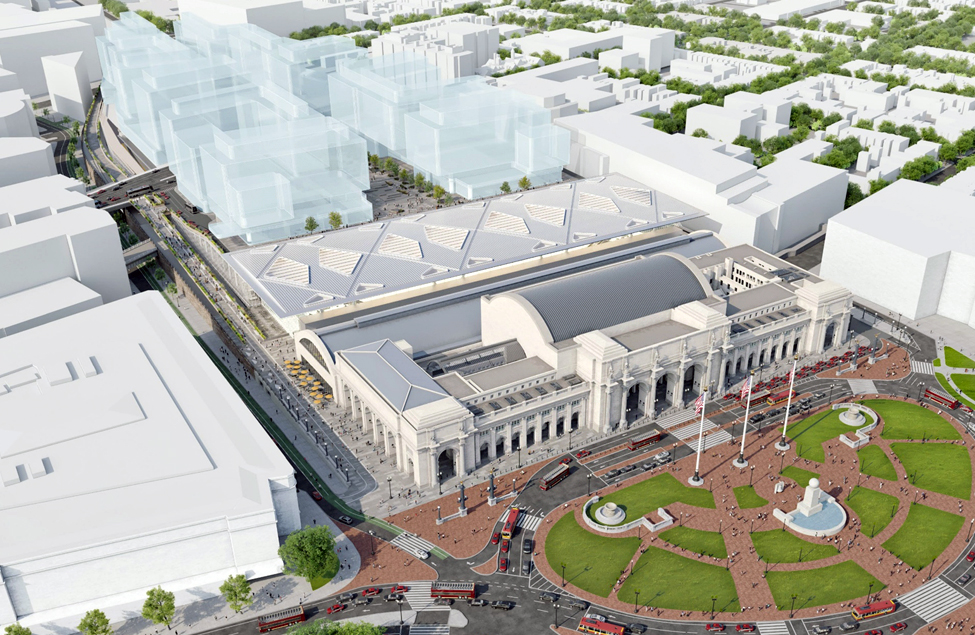
At its Thursday, July 7 Commission meeting, the National Capital Planning Commission (NCPC) provided comments to the Federal Railroad Administration (FRA) on revised concept plans for the Washington Union Station Expansion Project. The Union Station Redevelopment Corporation, in coordination with Amtrak, has proposed expanding and modernizing the multimodal transportation facilities at Washington Union Station to meet anticipated 2040 demand. The station, designed by Daniel Burnham and completed in 1908, is currently the second busiest in Amtrak’s network.
The project seeks to rebuild and reconfigure the station tracks and platforms (these would be widened and lengthened); add a new train hall with a contemporary design; rebuild the bus station and parking; add new concourses; and improve pick-up/drop off locations and pedestrian and bicycle access. The end result would be more train service (with a quicker turnaround time) and improved multimodal access.
Commission feedback provided at the January 2020 meeting focused on reducing proposed parking, having a better design quality, and improving coordination with interested parties and Akridge, the developer of an adjacent air rights project to be built over the tracks, As a result, FRA updated the design; reduced proposed parking by 50 percent (from 1,600 to 860 spaces, current parking is 2,200 spaces); relocated the parking from an above-ground deck to underground; and reconfigured the new bus facility to an east-west orientation to align with the new train hall.
The Commission strongly supported the updated submission and commended FRA for both developing a new plan that responding to their previous comments and improved coordination with Akridge. They requested further details about several access components for the next submission phase, including the design and operation of a proposed vehicular ramp on G Street, NW; the design of the west ramp, including how it will function for pedestrians and bicyclists, as well as the conditions during which the ramp would operate for vehicular use. They would also like to see a phasing plan that describes the timing and implementation of each project component. Regarding public testimonies about the new bus facility, the Commission requested the applicant continue to work with the bus operators and related stakeholders.
“I want to thank the Commission for its thoughtful review and attention to detail that will make this a better project. I also want to thank the design team for hitting the major reset button. The significant revisions have had a positive impact on the design,” said NCPC Chair Beth White. “I love how modern and open the train hall feels. It can be an incredible space.”
The Commission approved preliminary site development plans submitted by the National Park Service, in coordination with the Virginia Passenger Rail Authority, for the Long Bridge Corridor Project. Plans call for widening a 1.8-mile rail corridor with two new tracks resulting in a continuous railroad bridge over the George Washington Memorial Parkway; Mount Vernon Trail; Potomac River; Ohio Drive, SW; I-395; and the Washington Channel that would expand rail capacity between Washington and Virginia beyond the two tracks of the existing Long Bridge, originally constructed in 1904. The new bridge would be located 40 feet north of the existing one. A new pedestrian-bicycle bridge would parallel the new rail bridge over the Potomac River connecting Virginia’s Long Bridge Park with East Potomac Park.
The Commission supported the overall design approach, which would complement the historic bridge through a similar structure, material, and form. Among its comments, the Commission requested the applicant continue to refine the architectural detailing for the steel structure and size of the bridge piers. They thought that the proposed design of the pedestrian-bicycle bridge was overly complicated and large in scale and recommended a more neutral color scheme and wider bridge to allow for more users, an idea echoed in the many comments submitted by the public. Commissioners recommended possibly using new bridge pier designs for where the bridge would cross Ohio Drive, SW and the Washington Channel crossings. At its September 1 meeting NCPC will review the design for where the project extends over Maine Avenue, SW into Washington’s Southwest Commercial District adjacent to District of Columbia property.
NCPC provided feedback to the Department of the Army on the draft Arlington National Cemetery Real Property Master Plan. The plan calls for various changes to the previously approved master plan to incorporate future projects but does not propose expansion of the 639-acre cemetery outside of its current boundaries. Arlington National Cemetery was established in 1864 and is one of the oldest military cemeteries in the country. Each year the cemetery sees three million visitors and conducts six thousand funerals.
The draft master plan divides the cemetery into four area development plans: Entry Corridor (including Memorial Avenue, the Welcome Center, Women in Military Service for America Memorial, the existing visitor parking garage, and the Administration Building); Memorial Amphitheater; Service Complex; and the Meigs-Tanner area near Arlington House. Most of the plan’s proposed future projects are in the Entry Corridor. The plan also addresses the 16-acre Soldiers’ and Airmen Home National Cemetery located next to the Armed Forces Retirement Home in Northwest Washington, DC.
The Commission was in favor of the plan’s goals and overall approach and commended the plan’s commitment to maintain the cemetery’s mission and historic character. Among their comments, Commissioners had problems with proposed permanent vehicular screening on Memorial Avenue and recommended that the applicant explore options for non-permanent, mobile, vehicular screening. They also opposed locating any future columbaria or other structures in areas identified as flex space.
The Commission provided comments on concept plans submitted by the Army for an approximately 525,000 square foot distribution center to be located on Fort Belvoir’s North Area in Area D, a 26-acre parcel located on the area’s southwestern parcel. Components include a high bay warehouse; three-story administrative building; truck maintenance/refueling building; covered/enclosed storage buildings; two surface parking lots; an entry control facility, including gate house and vehicle inspection; and enhanced security measures along the fence line, including a new fence, an approximately 30-foot clear zone around the fence, and a maintenance and patrol path.
While the Commission supported several of the project’s components, it deferred support for the two parking lots, entry control facility, and perimeter fence until the Army provides additional information. They noted that the perimeter fence appears to be a new element not included in the previously approved Fort Belvoir North Area Development Plan (March 2022) and will probably impact trees, stream valleys, and wetlands. They requested more information on why this fence is needed on a secure facility, the number of trees that would be removed, and fence design options that would reduce the number of trees removed and streams and wetlands impacts.
Before adjourning, Smithsonian Institution representatives updated the Commission on the site evaluation study for the National Museum of the American Latino and the American Women’s History Museum. Per the enabling legislation, the Smithsonian must determine sites for both museums by the end of 2022. NCPC has an advisory role in the site selection process but will have approval authority over site and building plans for both museums. No action is taken on information presentations.
From an initial list of 27 potential sites, the Smithsonian developed a list of 15 Tier I sites in March 2022. Most recently, they identified four focus sites: the Arts and Industries Building, the South Monument Site (located across the National Mall from the National Museum of African American History and Culture); the Tidal Basin Site (located across Raoul Wallenberg Place, SW from the U.S. Holocaust Memorial Museum); and the Northwest Capitol Site (located across the Capitol Reflecting Pool from the U.S. Botanic Garden). While none of the Tier I sites have been ruled out, the Smithsonian stated they feel strongly about these four focus sites. Smithsonian staff and their consultant team are analyzing them in greater depth, reaching out to the agencies with jurisdiction of these sites to discuss acquisition potential, refining museum programs to inform site evaluations, and developing detailed site cost estimates. They plan to update the Commission with their analysis one last time in September.
Chair White underscored the importance of these museums, noting that the new museums reflect populations that are significantly under-represented in the commemorative landscape. Commissioners encouraged the Smithsonian to continue evaluating additional sites, noting the potential constraints on the focus sites. They noted the limited space and constraints on additional development on the National Mall and the importance of a longer-term strategy to provide sites for future museums and memorials beyond the Mall.
Commission actions and related materials are available online.
This month’s agenda included two consent calendar items (no presentations were given). Unless otherwise noted, all projects are in Washington, DC.
1. Preliminary site development plans for Foreign Missions Center Infrastructure Design, 16th Street, NW, between Aspen Street and Alaska Avenue, NW. (8382)
2. Preliminary site development plans for Cobb Park, 200 H Street, NW. (8379)
The Executive Director approved eight items under authority delegated by the Commission. Unless otherwise noted, the projects are in Washington, DC.
1. Preliminary and final building plans for the U.S. Department of Transportation Headquarters Antenna Upgrade, 1201 4th Street, SE. (8373)
2. Preliminary and final site and building plans for the Old Post Office Signage Replacement, 1100 Pennsylvania Avenue, NW. (8374)
3. Preliminary and final building plans for the Joint Base Anacostia-Bolling LEARN Charter School Temporary Trailers, 100 Duncan Avenue, SW. (8308)
4. Final site development plans for the Defense Intelligence Agency Headquarters North Entrance Revitalization Project, 200 MacDill Boulevard, SW. (8362)
5. Preliminary and final site development plans for the U.S. Coast Guard Hangar 14 Renovation, Camp Springs, Maryland. (8375)
6. Preliminary site and building plans for the Joint Base Myer-Henderson Hall Building 248 Renovation, Fort Myer, Virginia. (8377)
7. Preliminary site and building plans for the Response Robotics Research Test Facility Building 209, 100 Bureau Drive, Gaithersburg, Maryland. (8380)
8. Report to the Zoning Commission of the District of Columbia for a Text Amendment to Subtitles G, H, and I, Permit Matter-of-Right Residential Use. (ZC 22-01)

