 An official U.S. government website


Media Release
- By Stephen Staudigl
- February 07, 2022
NCPC Approves Joint Base Anacostia-Bolling Master Plan
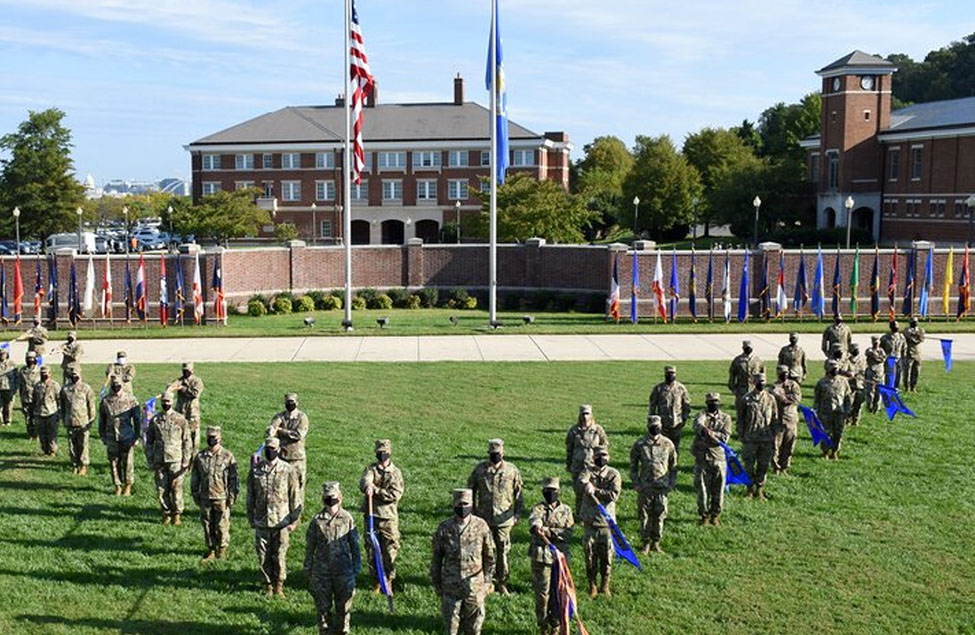
At its Thursday, February 3, 2022 online meeting, the National Capital Planning Commission (NCPC) approved the Joint Base Anacostia-Bolling Installation Development Plan (master plan), Historic Bolling District Plan, and Transportation Management Plan. Submitted by the U.S. Department of the Air Force, the plan seeks to transform the installation into a more environmentally sustainable base that supports multiple missions and preserves its historic heritage. The 966-acre installation is located on the Anacostia River in Southeast Washington, DC. It currently has 17,000 military and civilian employees.
NCPC noted that Joint Base Anacostia-Bolling is unique in that it is a large military installation in an urban area. Commissioners commented that the plan a very solid base on which to build upon and appreciated the environmental and resiliency-focused components. They also suggested that further planning be more aspirational and improve items including walkability, transportation, and connections to adjacent neighborhoods.
Per Air Force standards, there will be several more detailed district plans (the Historic Bolling District Plan is the first, three others will be submitted for NCPC review later this year) and area component plans. These plans will provide more details about mission requirements and planning objectives. The Air Force will also submit Installation Facility Standards for NCPC Review. These will include additional responses to Commission recommendations regarding surface parking, new tree planting areas, landscaping, architectural design, and renewable energy guidelines.
Joint Base Anacostia-Bolling was formed in 2010 from the merger of two historically separate military installations (the Naval Support Facility and the Anacostia and Bolling Air Force Base). The Air Force 11th Wing began serving as the installation’s planning and general administrative group on October 1, 2020, taking over from the U.S. Navy.
The Commission authorized staff to release the draft Monumental Core Streetscape Design Guidelines: Vertical and Surface Elements for a 90-day public comment period. These guidelines will help inform the development of coordinated and cohesive streetscapes in downtown Washington’s monumental core with a focus on the placement, configuration, and type of elements including trees, streetlight poles, landscapes and plantings, stormwater management, pavement materials, and sidewalks.
The guidelines are part of a comprehensive update of the Streetscape Manual by an Interagency Working Group. First written in 1992, the manual contains details and specifications that coordinate construction across federal and local jurisdictions on the National Mall and vicinity. Agencies use the manual’s details to guide development and hold regular working group meetings to coordinate streetscape projects. This provides consistent streetscapes on both federal and District land as projects are implemented. NCPC and the U.S. Commission of Fine Arts use the manual during project review to ensure projects use consistent elements and materials.
“I appreciate the Interagency Working Group’s collaborative efforts to develop the draft Streetscape Design Guidelines” said NCPC Chair Beth White. “This work is important for unifying and achieving consistency on streets within the downtown monumental core, and physically and visually connecting with our important national buildings, monuments, and open spaces, as well as surrounding local neighborhoods.”
The public comment period will run from February 9 to May 11, 2022. The draft guidelines will be available for review on NCPC’s website beginning on February 9. Public meetings will take place on Wednesday, March 23 (12:00-1:30 pm) and on Wednesday, March 30 (6:00-7:30 pm). Further information will be on the NCPC website.
NCPC staff provided an update on the Federal Capital Improvements Program (FCIP). One of NCPC’s core activities as defined by the National Capital Planning Act is to annually review and recommend a six-year program of federal capital projects for the National Capital Region and provide planning recommendations on these projects to the Office of Management and Budget (OMB) prior to the release of the President’s budget. NCPC uses the FCIP to help guide planning and development in the region. Each submitted project is evaluated with a scorecard to gauge consistency with Comprehensive Plan policies, NCPC-approved master plans, site and building plans, plans and policies, and other federal interests. A project's inclusion in the FCIP neither represents a commitment by a federal agency to propose funding, a commitment by OMB to approve funding, nor NCPC’s approval of a project. Additionally, NCPC staff prepare an annual report of federal capital projects that received funding in the President’s budget.
Inspired by recent Executive Orders, the FY2023-2028 FCIP includes several changes. New questions ask how submitting agencies are considering climate change and equity impacts for each capital project. Climate change questions include ones related to the incorporation of renewable energy, water conservation, and greenhouse gas reduction. Equity questions include ones related to location in or near an Equity Emphasis Area, potential impacts on underserved communities, and economic development impacts. These new questions will be phased in, with answers in this FCIP cycle used as supplemental information. The questions will then be evaluated and adjusted, if needed, before becoming an official part of the project evaluation process in the FY2024-2029 FCIP. No official Commission action is taken on information presentations.
Commission actions and related materials are available online.
This month’s agenda included three consent calendar items (no presentations were given). Unless otherwise noted, all projects are in Washington, DC.
1. Approval of the final master plan for the Wolf Trap National Park for the Performing Arts General Management Plan Amendment, 1551 Trap Road, Vienna, Virginia. (MP007)
2. Approval of preliminary site and building plans for the Wolf Trap National Park for the Performing Arts - Concession Stand A, 1551 Trap Road, Vienna, Virginia. (8341)
3. Comments on concept plans for the New Fort Dupont Ice Arena, 3779 Ely Place, SE. (8343)
The Executive Director approved two items under authority delegated by the Commission. Unless otherwise noted, all projects are in Washington, DC.
1. Approval of preliminary site and building plans for the Southeast Neighborhood Library Modernization and Expansion, 403 7th Street, SE. (8342)
2. Report to the Zoning Commission of the District of Columbia for the Capitol Gateway Zone Design Review at Square 653, 1301 South Capitol Street, SW. (ZC 21-27)

