 An official U.S. government website


- By Bsrat Mezghebe
- April 28, 2021
A Vision for Sustainability: Revisiting the SW Ecodistrict Initiative
Launched in 2011, the SW Ecodistrict Initiative, and the resulting SW Ecodistrict Plan: A Vision for a More Sustainable Future (2013), were recently in the news as Congresswoman Eleanor Holmes Norton responded to the proposed American Jobs Plan, President Biden's infrastructure bill.
“President Biden’s American Jobs Plan, together with the Smithsonian’s need for space for the recently authorized women’s history and Latino museums, offers the opportunity to create a new D.C. neighborhood and to connect the National Mall with the Southwest Waterfront,” Norton said.
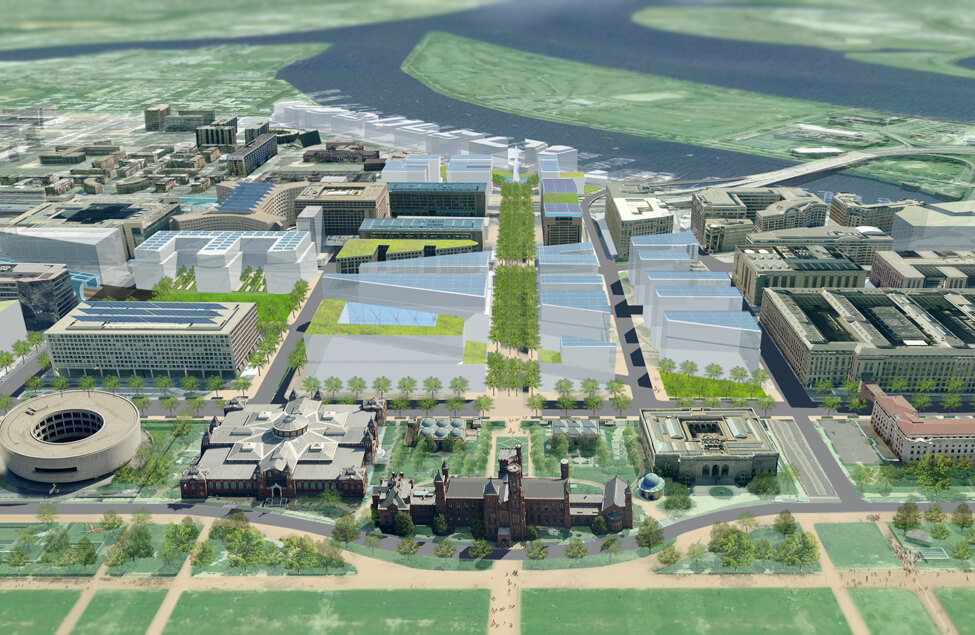
The initiative, led by NCPC in coordination with the District Office of Planning and a task force comprised of 17 federal and local agencies, is an innovative approach to transform an isolated federal precinct south of the National Mall into a highly sustainable workplace, livable neighborhood, and high-performance environmental showcase. With the administration's focus on climate, resilience, and infrastructure, now is a good time to revisit the initiative’s aggressive resilience goals and see what has been accomplished to date. These goals include using federal land and resources more efficiently, showcasing best practices in sustainable energy and water use, increasing freight and commuter rail travel, and removing infrastructure barriers that sever the Northwest and Southwest neighborhoods from each other.
- Neighborhood Revitalization: The district will accommodate 19,000 additional federal employees, create 1.8 million square feet of residential and hotel development, and better connect the monumental core to the Southwest Waterfront. An expanded L’Enfant Station will meet increased transit demand as a nexus of commuter rail, Metro, and bus service.
- Environmental Stewardship: Buildings will be rehabilitated or redeveloped to increase energy efficiency and lower greenhouse emissions by 51%. Potable water consumption will be reduced by 70% and all stormwater will be repurposed for irrigation of the area’s public spaces and other non-potable uses. Green infrastructure such as roofs, parks, and streetscapes will cover 40% of the district with tree canopy, providing pedestrian comfort and enriching urban life.
- Economic Vitality: Leveraging public and private investments will maximize benefits and provide a template for rehabilitation and reuse of federal properties. Potential new memorial and museum destinations will attract more visitors to Southwest Washington.
Banneker Park and L’Enfant Promenade Improvements
The SW Ecodistrict Plan expanded upon the Monumental Core Framework Plan's (2009) vision to create an inviting civic corridor along 10th Street, SW between the National Mall and Southwest Waterfront. An important element is an improved Banneker Park, the eight-acre park at the end of the L’Enfant Promenade named after Benjamin Banneker, an African-American scientist who helped survey Washington’s original boundaries. Although currently underused, a new cultural use can extend the civic qualities of the National Mall and reclaim views to the Potomac River.
NCPC’s study to improve connections from the park to the waterfront was ultimately funded and completed through a partnership between the National Park Service, Hoffman Madison Waterfront, and the District of Columbia. NCPC approved ZGF Architects’ designs for a staircase, paved paths, tree and embankment plantings, enhanced lighting, and integrated stormwater management. Opened in 2018, the connections make it easier to walk and bike from the National Mall to the Maine Avenue Fish Market and The Wharf, a private waterfront development.
Placemaking along the 10th Street Corridor
In 2019, the International Spy Museum opened its new 140,000-square-foot facility on 10th Street in L’Enfant Plaza. The SW Business Improvement District partnered with the museum and real estate company JBG SMITH to install streetscape improvements along L’Enfant Promenade to make it more enjoyable for visitors. These include new tree planters along the northern end, reviving the landscaping along the southern portion, and adding tables and chairs throughout the promenade.
Rail Expansion
There have been several efforts to increase commuter and passenger rail capacity through the corridor and to the rest of the city. These include the District’s Maryland Avenue Decking Study; the recent completion of the Long Bridge environmental record of decision; and ongoing planning for rail expansion by the Virginia Department of Rail and Public Transportation, the Federal Railway Administration, and the District Department of Transportation. The addition of a four-train track system along Maryland Avenue is also an opportunity to eliminate infrastructure barriers and reconnect the street grid.
SW Ecodistrict Initiative

