 An official U.S. government website


Media Release
- By Stephen Staudigl
- January 08, 2021
Commission Updated on Status of Monumental Core Streetscape Design Guidelines
At its Thursday, January 7, 2021 online meeting, National Capital Planning Commission (NCPC) staff provided the Commission with an update on development of Streetscape Design Guidelines for Washington’s monumental core. Developed by an Interagency Working Group consisting of representatives from 11 federal and local stakeholder agencies, the guidelines will assist in the future development of streetscapes in downtown’s monumental core, in and within the vicinity of the National Mall and other important federal locations.
The existing Streetscape Manual from 1992 is administered through a memorandum of agreement among the agencies and contains details and specifications that coordinate construction across federal and local jurisdictions on and around the National Mall. Federal and local agencies currently use the manual when developing streetscape projects in this area and hold regular working group meetings to coordinate them.
The Monumental Core Streetscape Project is multi-phased update of the manual led by NCPC. The new guide will inform the future character and quality of civic streetscapes and improve connections and relationships between the monumental core and surrounding local areas. It has three components: an Urban Design Streetscape Framework & Lighting Policy, streetscape design guidelines, and a streetscape construction manual,
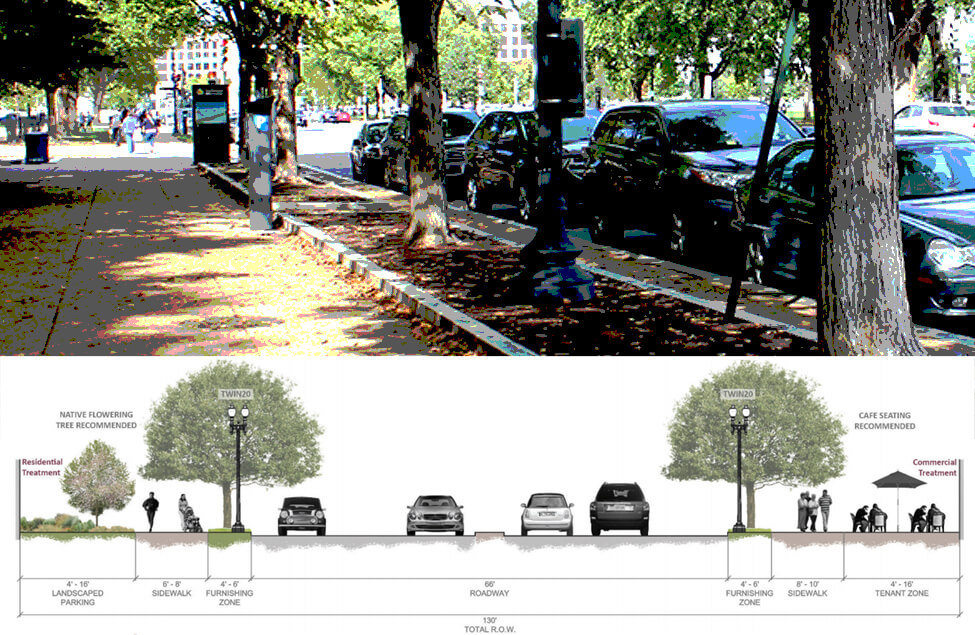
The updated manual’s streetscape design guidelines will address items including vertical elements (such as streetlights and street trees) that impact streetscape corridors and frame vistas; surface elements (pavement including sidewalks, the street, curbs, gutters, and landscape) that inform a streetscape’s character; and small-scale elements (benches, trash cans, and bike racks) that inform individual neighborhood character. Today’s presentation focused on the vertical elements which are organized into two topics: streetlight fixtures which address streetlight types, heights, and placement; and recommendations for lighting improvements on the National Mall’s crosswalk panels.
The current Streetscape Manual has a limited streetlight fixture palette with historic Twin-20s and Washington Globes, which are found throughout the city, and Olmsted Lights which are located exclusively on the National Mall. The current work expands this to include special street lighting fixtures (including Pennsylvania Avenue’s tiered suite of lights; the Capitol Ground’s Ladder Rest Globes; Kutz Bridge’s Saratoga lights; the globes on 10th Street, SW; and the Kennedy Center’s unique fixtures). The new guidance also adds details including fixture heights and spatial configurations.
The manual will also include guidelines to improve lighting for the National Mall’s panel crosswalks that balance pedestrian safety with historic preservation. The recommendations seek to maintain the dimly lit character of the nighttime east-west vista along the Mall’s center panel while improving illumination of the crosswalks to make it safer for pedestrians.
The Street Tree Guidelines were organized into four topics that address tree canopy; tree form, sensory attributes, and planting patterns; tree health and function; and tree box treatments. The current Streetscape Manual specifies disease resistant American Elms for important streets but does not address contemporary trends in arboriculture, including species biodiversity and improved resilience to pests and diseases.
The guidelines focus on restoring a more robust tree canopy and how trees shape streetscape character, viewsheds, and vistas, while also taking into consideration tree health and recognizing that trees are a complex system of living organisms. The new guidelines promote consistent tree forms and mature heights to clearly frame view corridors to important structures and open spaces. The focus on tree form will increase the plant pallet improving biodiversity and tree health.
The working group is currently drafting surface element guidelines. Once those are complete in the fall 2021, they will return to the Commission for preliminary approval. Upon preliminary approval, guidelines for small-scale elements will begin. The new streetscape guide will be used by agencies during the design, coordination, and review of projects in the monumental core.
This month’s agenda included two consent calendar items (no presentations were given):
1. Final site and building plans for the Humphreys Engineer Center Battalion Operations Facility, 7910 John J Kingman Road, Fort Belvoir, Virginia. (8216)
2. Preliminary and final site development plans for the EPA West Building T-Mobile Antenna Installation, 1301 Constitution Avenue, NW. (8236)
The Executive Director approved two items under authority delegated by the Commission:
1. Preliminary and final site development plans for phase 2 of building envelope repairs for the Martin V.B. Bostetter, Jr. United States Courthouse Building, 200 South Washington Street, Alexandria, VA. (8190)
2. A report to the Zoning Commission of the District of Columbia for Text Amendments to Permit Animal Care Uses in Mixed-Use Areas. (ZC 20-20)
Commission actions and related materials are available online..

